To build a brand on social media, decide who you are talking to and what you promise them, write that down as a one-page brand sheet, keep your name, bio and look the same on every network, and post on a few fixed themes steadily. Then measure what people do and adjust once a month.
This guide is practical and based on a few primary sources, read on October 22, 2026: TikTok's Creator Academy, Instagram's creator guidance and Help Center, and the US Federal Trade Commission's disclosure guide for social media influencers. It gives seven steps, a brand sheet you can copy, what to adapt per network, and how to keep it consistent when you post to several networks.
What a brand on social media actually is
A brand is what people expect when they see your name. On social media that expectation comes from three things repeated over time: what you say, how you say it and how you look. If a stranger can describe your account in a sentence after three posts, you have a brand. If they cannot, you have a feed.
It is not a follower count. TikTok's recommendation page says follower count is not a direct factor in recommending videos, and that previous high-performing videos are not either. A small account with a clear point of view can reach people. A big account with no focus gets scrolled past.
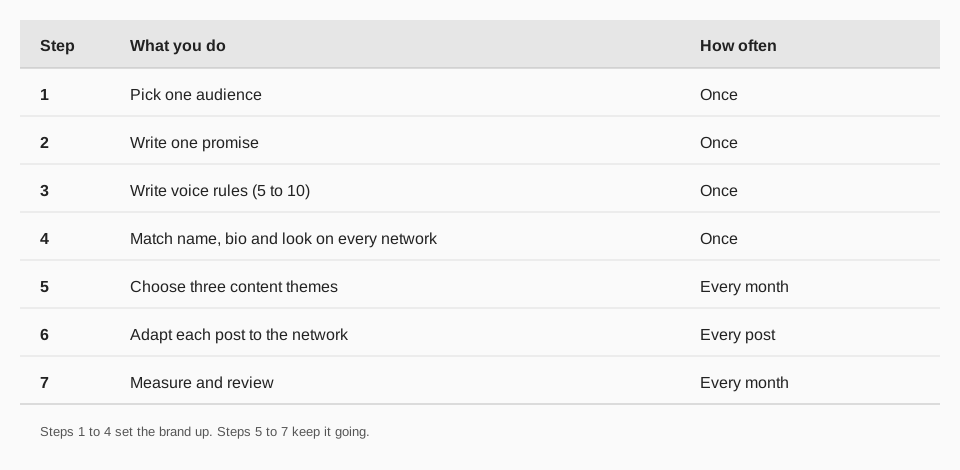
How to build a brand on social media in 7 steps
Step 1: Pick one audience
Write one sentence: "I help [who] do [what]." TikTok's Creator Academy puts it as "know your audience to grow your audience", and suggests identifying your audience's interests and building content around specific topics. Pick the person you would be happiest to hear from, not everyone who might click.
Step 2: Write one promise
The promise is what a follower gets every time you post. "A practical tip about bread you can use tonight" is a promise. "Content about food" is a category. A good promise is narrow enough that you can say no to ideas that do not fit.
Step 3: Write your voice rules
List five to ten rules that a new teammate could follow. For example: we write in the second person, we use short sentences, we never use jargon without explaining it, we use one emoji at most, we answer comments within a day. Add three phrases you always use and three you never will.
Voice is where brands blur most when several people post. A short rule sheet is cheaper than rewriting posts later.
Step 4: Match your name, bio and look everywhere
Use the same handle where you can, the same profile image, and a bio that says the promise in the first line. Bio length differs by network. Instagram's Help Center says you can write a bio of up to 150 characters, so write your promise to fit that, then lengthen it where there is room.
Put your link where each network wants it. Instagram's Help Center says you can add up to five websites under Edit profile, then Links. Our guide to the link in bio on Instagram shows how.
Step 5: Choose three content themes
Three themes give you variety without losing focus. A bakery might use: how-to tips, behind the scenes, customer stories. Rotate through them so no two posts in a row look alike. Instagram's creator guidance advises creators to consistently publish original work, so build the plan around what only you can show.
Put the themes on a calendar so the rhythm is visible. Our Instagram content calendar guide works for other networks too.
Step 6: Adapt each post to the network
Same brand, different packaging. A LinkedIn post can run longer and more formal, a TikTok is a video with a hook in the first second, and a Pinterest Pin is an image people save. Keep the promise and voice the same, and change the length, format and call to action.
TikTok's Creator Academy also says that, to keep a feed diverse, its system measures content similarity and switches out videos that repeat the same sound, so lean on your own angle rather than a copy of what everyone else posts. See our guide to cross-posting on social media for what to change each time.
Step 7: Measure and review monthly
Once a month, look at which theme and which network brought the most of what you want: clicks, replies, saves or visits. Keep the themes that work, drop one that does not, and test a new one. TikTok's Creator Academy suggests checking watch time and finish rate to find patterns in the videos that did well. For how to read the numbers, see our guide to calculating engagement rate.
A brand sheet you can copy
Put these six lines in a shared document. Anyone who posts for you should be able to use it without asking.
| Field | What to write | Example (a bakery) |
|---|---|---|
| Audience | One sentence about who it is for | Home bakers who want reliable bread |
| Promise | What every post gives them | One tip you can use tonight |
| Voice | 5 to 10 rules, 3 phrases to use, 3 to avoid | Second person, short sentences, no jargon |
| Name and bio | Handle, profile image, first-line bio | Same on every network |
| Themes | Three recurring post types | Tips, behind the scenes, customer stories |
| Link | Where every call to action points | One page, one tracked link per post |
The example is invented to show the format. Replace it with your own.
Follow the rules when you work with partners
If you post about a product or partner you have a relationship with, disclose it. The FTC's guide Disclosures 101 for Social Media Influencers says to disclose any financial, employment, personal or family relationship with a brand, including free or discounted products. It says to place the disclosure where it is hard to miss, in the video or image itself, and to use plain terms like "ad" or "sponsored" rather than vague labels like "sp" or "collab".
Brand consistency includes trust. Writing disclosure into your voice sheet means no one on the team has to guess.
How to keep a brand consistent with TrackMedia
TrackMedia puts the brand sheet into practice for the networks you post to. You write the post once in a single composer, and TrackMedia fits a version to each of its 21 networks, so your voice stays the same while length, format and links change. Preflight checks catch a post that will not fit a network before it goes out, and a media library keeps your approved images and logos in one place.
The calendar and posting queues turn your three themes into a schedule. Content collections fill queue slots, so a "tips" collection feeds your tip slots and a "customer stories" collection feeds the others. Mentions, first comments and alt text carry over. If you work with a team, crosspost rules with a review step let someone approve a post before it goes out.
Measurement matches step 7. Tracked links with UTM tags show clicks, visitors and referrers per post and per network, and cross-network analytics include posts you did not publish with TrackMedia. A "Best times" view built from your own posts helps you schedule. The AI assistant can help you draft a version. See how publishing works in TrackMedia, or start free: 15 posts a month, no card.
If you run more than one account, read how to manage multiple social media accounts and our social media management workflow.
Questions people also ask
How do you build a brand on social media from scratch?
Pick one audience and one promise, write voice rules, match your profile everywhere, choose three content themes, and post steadily. Review the results monthly.
How long does it take?
The platforms we read publish no timeline. Judge progress by whether the same kinds of posts keep working month after month.
Do I need a presence on every network?
No. Start with the one or two where your audience already is, and add a network when you can keep its posts up.
Should I post the same thing everywhere?
Keep the message and voice, change the format to suit each network (step 6).
Do follower numbers matter?
Less than people think for reach. TikTok says follower count is not a direct factor in its recommendations, and Instagram says creators of all sizes have an equal chance of reaching new audiences with reels.
How we checked this
We opened each page below on October 22, 2026. The steps and the brand sheet are our own advice; the platform and legal facts come from these pages.
- Decoding TikTok's Recommendation System (TikTok Creator Academy): audience tips, content similarity, checking watch time and finish rate.
- How TikTok recommends videos #ForYou (TikTok Newsroom): follower count and past performance are not direct factors.
- Finding success on reels in 2025 (Instagram for Creators, January 21, 2025): creators of all sizes, publish original work.
- Add a bio to your Instagram profile and Add a website to your Instagram profile (Instagram Help Center): the 150-character bio and the five links.
- Disclosures 101 for Social Media Influencers (US Federal Trade Commission): when and how to disclose.